Sustainable Food
Author: Nick Lancaster (Dec 2025)
Growing up as one of six children on the northern edge of Manchester, I remember mealtimes as something special. Both my parents worked, so my eldest sister often prepared ‘tea’, as we called it. Her limited cooking skills meant I learnt early, and this interest later shaped a career in hospitality, from pubs to high-end hotels. Food has therefore always been at the heart of my life, and it now sits at the centre of some of the most pressing crises we face, climate, nature, and the cost of living.
Food systems account for roughly 30% of all global greenhouse gas emissions, a figure consistently identified in international assessments (FAO, 2021). Closer to home estimates for Cumbria place food-related emissions at around 25% of the county’s total, linked primarily to residents rather than visitors (Small World Consulting, 2022). These are not small numbers, yet they often receive less attention than energy or transport.
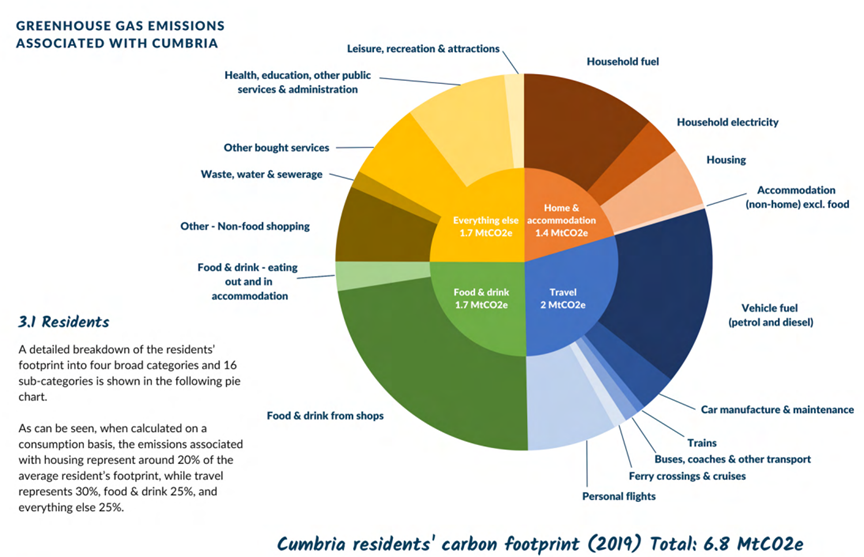
(Summary of Greenhouse Gas Emissions in Cumbria ZCC 2023)
Another striking statistic is that around 60% of the world’s mammals consists of livestock reared for food, while wild mammals represent only a tiny fraction of what once existed (Bar-On et al., 2018). Our global food system, and particularly livestock production, therefore, plays a major role in land use, deforestation, biodiversity loss, and emissions.
Despite food’s enormous environmental impact, we spend on average 10% of household income on food, a proportion that has fallen over time while the true cost to nature has increased (DEFRA, 2023). Yet perhaps the most astonishing figure is that around one‑third of all food produced is wasted somewhere along the supply chain (UNEP, 2021). This waste occurs while the World Food Programme supported 124 million people experiencing food insecurity in 2024 (WFP, 2024). In the UK the cost to an average family of four is estimated at £1000. (WRAP 2022) The contradiction between abundance and hunger could not be more stark.
Locally, increasing interest in sustainable food is growing and provides opportunities for positive action from reducing food waste and supporting regenerative farming to encouraging seasonal, climate positive diets. These small individual choices, when scaled across communities, can reduce emissions, strengthen local food resilience, and lessen pressure on natural ecosystems.
But what can you do and how to make a start? We all make choices with our food everyday. You have an opportunity to take positive decisions that help climate, nature and your pocket, consider some of the following ideas.
Cut down waste
- Plan your meals, organise your fridge and only buy what you need.
- Manage your portion, don’t overload your plate.
Choose local and seasonal food
- Support Cumbrian (or British) farmers where possible by eating food that is grown closer to home and in our natural climate.
- Avoid food flown in from abroad or out of season produce that relies on heated greenhouses.
Take care with meat and dairy
- Red meat and dairy can have high carbon footprints, view it more as a luxury item. Buy and use less but invest in sustainably reared, high welfare produce.
- Embrace different cuts, so there is less waste from an animal.
- Consider portions size, the NHS recommends eating no more than 70g of red meat a day for a healthy diet
Eat more beans, nuts and pulses
- You can replace some of the meat with pulses such as lentils, which are high in protein and fibre whilst also being low in fat and lower in cost.
- Nuts are good for you too, they’re loaded with nutrients and antioxidants
Give fruit and veg a little more space
- Full of essential vitamins, minerals, and fibre; what’s not to love
- You can always eat them raw, which is healthier and saves cooking energy.
The evidence is clear: addressing food is one of the most powerful levers available to tackle climate and nature emergencies. Unlike global energy infrastructure or national transport policy, food is something we can influence every single day.
References
Bar‑On, Y.M., Phillips, R. & Milo, R. (2018) ‘The biomass distribution on Earth’, PNAS, 115(25), pp. 6506–6511.
DEFRA (2023) Family Food Survey 2023. Department for Environment, Food & Rural Affairs.
FAO (2021) The State of Food and Agriculture. Food and Agriculture Organization of the United Nations.
Small World Consulting (2022) Cumbria Carbon Baseline Report. Small World Consulting Ltd.
UNEP (2021) Food Waste Index Report 2021. United Nations Environment Programme.
WFP (2024) Annual Food Security Update. World Food Programme.
WRAP (2022) Household Food and Drink Waste in the UK 2022. The Waste and Resources Action Programme (WRAP)