
The aim of the bat sound monitoring project is to increase the number of records of bats within the River Duddon’s catchment using bat detectors. These detectors are able to detect sound in the ultrasonic range that bats use to echolocate. Bats use echolocation to navigate in the dark, to find their food (e.g. moths, midges, beetles, spiders and more!) and also communicate with other bats.
Different bat species have different echolocation calls which allows the identification of the bat, often to a species, but sometimes to a genus level. This information helps us to learn which habitats are being used by which bats and when in addition to which areas support a diverse range of species and which don’t. This can help build a broader picture for bat conservation in the valley. Plus it’s a lot of fun!
The group has used a combination of different bat detectors to record bat sounds with a semi-automated bat sound analysis protocol to collect over 30,000 recordings between March and October 2025. The results have shown the following bat species are using the catchment:
- Common pipistrelle Pipistrellus pipistrellus
- Soprano pipistrelle Pipistrellus pygmaues
- Natterer’s Myotis nattereri
- Daubenton’s Myotis daubentonii
- Noctule Nyctalus noctula
- Brown long-eared Plecotus auritus
- Whiskered and/or Brandt’s [1] Myotis mystacinus / Myotis brandtii
There have also been other calls detected that could only be identified to genus level including those from the Myotis, Nyctalus and Pipistrellus genera.
Project Aims
Monitoring of bat sounds is a part of a wider project to protect, conserve and enhance the status of habitats and species within the Duddon Valley. Bats produce sounds in the ultrasonic range (above the frequencies that humans can hear) to navigate through their environment at night, to find food and to socialise and communicate with other bats. Bats can be identified from these sounds as many species have different calls. By recording, monitoring and analysing the ultrasonic calls, we can begin to learn which species are using the different areas of the Duddon Valley and better understand which habitats are important areas for foraging and commuting bats.
Project Plan and Field Work
The Duddon’s catchment is not small, at approximately 21 miles in length from its southern areas around Barrow-in-Furness up to Cockley Bridge, it was realised a strategic approach was needed to try to cover as much of the catchment in one year’s survey season.
The catchment was split into a grid of 500 m by 500 m squares which were randomly sampled throughout the active bat season. A static bat detector was deployed in each chosen square in the most suitable location that could be achieved between March and October 2025. This included a variety of habitats and altitudes from upland fell acid grasslands, mires and heaths to woodlands and bogs such as the Mosses in the lower lying areas.
The bat detectors used were Titley Chorus detectors with ultrasonic microphones that used GPS positioning to determine the sunrise and sunset times. The detector activates approximately 30 minutes before sunset and switches off approximately 30 minutes after sunrise the next morning. It lies dormant, patiently waiting for ultrasonic calls of bats. Once detected, the recorder activates and saves the recording of the bat (or bats) to a memory card for analysis later.
The detectors were deployed almost constantly between March and October, inclusive, in 2025 for a period of approximately 3-5 days at each square. This typically resulted in anything from 100 to 7000 sound recordings per square depending on the level of bat activity.
The recordings could then be analysed… and this is where the need for a semi-automated process became apparent.
Project Analysis
Bat sound files are often analysed visually by reviewing the sonogram of the recording. Different bats produce different types of calls depending on the habitat that they are in, the prey that they hunt, their hunting style and the type of interactions they have with other bats.
As an example, a noctule Nyctalus noctula often hunts in open areas including grasslands and pastures, open woodlands and riparian habitats – these could be classed as habitats that are less cluttered and have few obstacles that the bat could collide with. Because noctule hunt in more open areas, they generally do not need to produce very high frequency calls, but instead produce lower frequency calls that are able to travel greater distances. This could be likened to a whale producing deep sounds that travel for miles through the ocean. Higher frequency calls attenuate over a shorter distance than low frequency calls and are better suited to use when flying through or hunting in more cluttered environments, such as a dense woodland. A bat that hunts in more cluttered environments includes the Natterer’s bat Myotis nattererii which forages very close to leaves of trees and is able to glean spiders from their webs. This species needs a lot of high frequency calls to provide it with a very detailed image of the habitats surrounding it when hunting and flying through these cluttered environments.
Therefore, the call sound and resulting sonogram differs between species and can be used to help identify the bat to a species. Some species from the same genus, however, can have very similar calls and can be very difficult, if not impossible, to tell apart. An example of this is the whiskered and Brandt’s bats Myotis mystacinus and Myotis brandtii, respectively.
The initial aim was to analyse these bat sounds manually using sonogram viewing programmes. Unfortunately, the sheer volume of bat calls that were being collected meant that a different approach was needed.
Enter the BTO Acoustic Pipeline. Or the BTO Pipeline for short. This uses a “classifier” to determine what species produced a sound and it is capable of identifying bat sounds through the dedication of Stewart Newson and his team at the British Trust for Ornithology. The BTO Pipeline is an automated programme that compares sound files with a library of tens of thousands of bat recordings and is able to identify bat calls to an accuracy in the range of 93-100%. Manual verification is still needed as the software can sometimes become “confused” by sounds within the recording, where bats are behaving differently to how would be expected or if the sound recording is of poor quality. An example of this is when a common pipistrelle is flying within an uncluttered environment (I.e. out in the open). The bat often changes the frequency range of it call to a low frequency which can, on occasion, trick the BTO Pipeline into thinking the call originated from a different species of bat, it’s larger cousin, Nathusius’s pipistrelle.
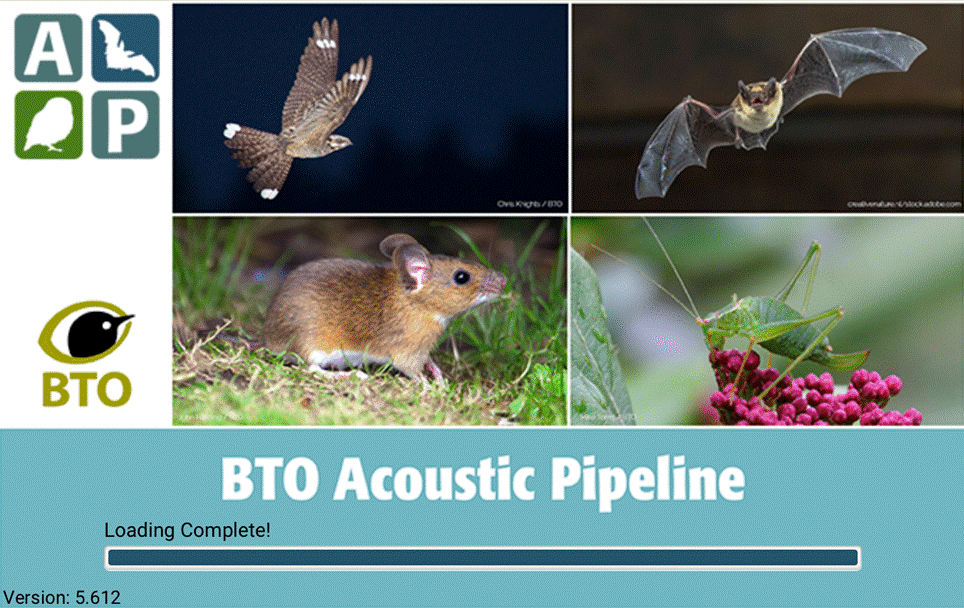
Figure 3: The BTO Acoustic Pipeline has a desktop application and webpage application used to identify sounds made by a variety of species, both acoustic and ultrasonic (including bats).
Therefore, a “semi-automated” approach was used to analyse the results. A protocol was developed for 2025 using information from Warwickshire Bat Group:
- Run all sound files through the BTO Pipeline.
- Review the results and identify any sound files where the BTO Pipeline has assigned a probability that its identification is correct of less than 0.7. These files are manually analysed to confirm or correct the identification.
- Any sound files that have been identified as from species that are uncommon and/or less well recorded are analysed manually to confirm or amend the identification. Examples included automatic identification of Nathusius’s pipistrelle Pipistrellus nathusii andalcathoe Myotis alcathoe.
- Compile a final list of species records from the semi-automated bat sound analysis.
This process resulted in a more efficient analysis of the bat sounds from across the Duddon Valley Catchment, allowing more survey time and more data collected.
[1] Whiskered and Brandt’s bats are of the Myotis genus and are often referred to as the small Myotis. Their calls are very similar and it is generally accepted that these calls cannot be separated in manual analysis. Therefore, where a whiskered or a Brandt’s bat was detected, it was considered this call could have been produced by either one of these two species.